Approach
Approach operations at EDNY are characterized by a highly flexible and vector-based arrival environment rather than strict procedural sequencing. Due to the airport’s compact regional airspace structure, approaches are frequently shortened and adapted dynamically depending on traffic volume, weather conditions and runway configuration.
Both instrument and visual transitions are commonly used during daily operations. Crews should expect a combination of radar vectoring, direct routings and shortened approach profiles, particularly during low and moderate traffic situations. Full published procedures are available and may be flown when required, but operationally, ATC will often prioritize efficient sequencing and minimal track miles.
Approach environments at EDNY can vary significantly between RWY 06 and RWY 24 operations. While RWY 24 generally supports more conventional straight-in profiles, RWY 06 operations frequently involve visual transitions, shoreline vectoring and shortened final approach setups.
Due to the close interaction between IFR airline traffic, general aviation activity and regional airspace constraints, continuous situational awareness and early approach preparation remain essential during all arrival operations into EDNY.
RWY 06 – Approaches
RWY 06 operations at EDNY support multiple approach transition concepts depending on arrival direction, traffic conditions and weather situation. Due to the airport’s flexible and vector-based arrival environment, approaches are frequently adapted dynamically by ATC in order to reduce track miles and improve sequencing efficiency.
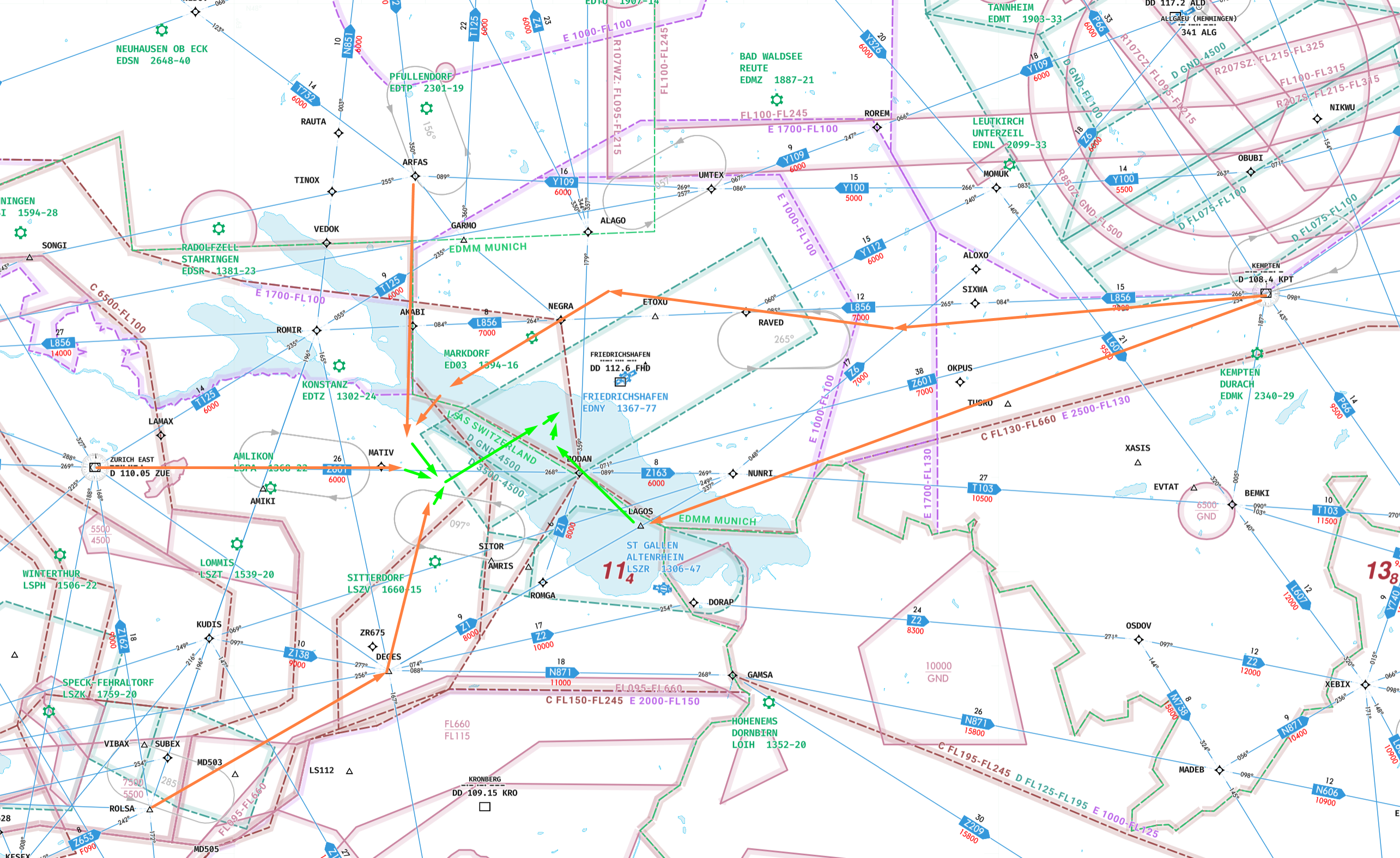
*orange is the conection between the entry point and tansition into the final approach sector. Green are the expected turns into the final approach.
Aircraft arriving via ARFAS will commonly receive transition towards the ILS environment via NY610 rather than entering a conventional downwind pattern. This transition typically results in a relatively direct setup onto the instrument approach environment for RWY 06 with minimal vectoring requirements under normal traffic conditions.
Depending on sequencing requirements and traffic density, additional radar vectors may still be issued prior to final intercept.
Arrivals via ROLSO (from DEGES) and ZUE commonly receive direct vectoring towards a straight-in approach setup for RWY 06. These arrivals typically involve minimal transition phases and are operationally preferred whenever traffic conditions permit efficient direct sequencing.
During favorable weather and clear visibility conditions, aircraft may receive direct routing towards LAGOS (RNAV waypoint) for the southern visual arrival environment into RWY 06.
From LAGOS, ATC will typically provide visual vectoring south of the airport along the Lake Constance shoreline before turning aircraft onto a shortened visual final approach. This transition is primarily used during VFR conditions and allows highly efficient arrival sequencing with minimal track miles.
Due to the close proximity of recreational VFR traffic along the lakeside area, increased situational awareness is required throughout the visual transition phase.
RWY 24 – Approaches
RWY 24 operations at EDNY generally support more conventional and stable approach profiles compared to RWY 06 operations. Due to the runway orientation and surrounding airspace structure, arrivals are frequently sequenced using extended downwind transitions or direct vectoring towards the ILS environment depending on arrival direction and traffic situation.
Aircraft arriving via ARFAS will commonly receive direct transition into the standard ILS approach environment for RWY 24. Due to the favorable arrival geometry from the west, only minimal vectoring is usually required before interception of the final approach course.
This arrival concept is operationally preferred whenever traffic conditions allow uninterrupted sequencing.
Traffic arriving from KPT can expect radar vectoring or direct routings towards the final approach environment for RWY 24. Depending on sequencing requirements, aircraft may either receive shortened vectoring directly onto the ILS or transition through modified arrival paths before final interception.
Due to the compact airspace environment around EDNY, these arrivals are frequently optimized to reduce unnecessary track miles.
Arrivals via ZUE are commonly routed towards UMTEX before entering the northern downwind for RWY 24 operations. From the downwind, aircraft are typically vectored onto base and subsequently established on final approach.
Aircraft arriving via ROLSO (from DEGES) can frequently expect direct routing towards HOFAZ in order to establish the southern downwind for RWY 24 operations.